|
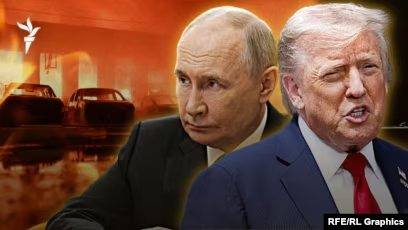
Exasperated with the apparent impasse in the negotiations to end the war between Russia and Ukraine, the White House has reportedly given Ukrainian president Volodymyr Zelensky an ultimatum: sign up to a peace deal by Christmas or else. In a separate interview with a US journalist, Donald Trump ramped up the pressure on Ukraine and Europe, urging Zelensky to “play ball” because Russia “has the upper hand” and ridiculing European leaders as talkers who “don’t produce”.
At the moment, Trump clearly thinks that it is the Europeans and Zelensky who are the problem. What he doesn’t appear to understand is that, even if Zelensky were to accept the current plan, Putin would still not agree to Trump’s deal. The US president thinks that the Kremlin would sign the deal because “Russia has the upper hand”. But that is precisely why Putin will not – he doesn’t have to.
Here is Putin’s likely decision calculus, which most Western analysts don’t seem to comprehend.
First, Putin has sufficient manpower and materiel to fight a protracted war over an issue he considers to be existential – to confirm Ukraine as part of Russia’s strategic security perimeter, on which Moscow has relied for centuries. The territory of Ukraine forms a part of Russia’s version of the US Monroe doctrine, so much so that Putin has shown he is willing to risk escalation to the levels of the Cuban missile crisis to exert his will over it. Russia’s advantages – in the size of its armed forces, in its weapons arsenal, in its military-industrial capacity, in its war-fighting style, and in its high tolerance for human casualties – give Putin the confidence to play a high-stakes game with Trump and Nato.
Russia currently has around 1.32 million active duty personnel, a number that is expected to increase to 1.5 million by virtue of Putin’s 2024 presidential decree. By contrast, Ukraine is in a manpower crisis, with the average age of a Ukrainian soldier reportedly having reached almost 45, despite allowing men as young as 25 to enlist in the military. Combined with Moscow’s military-industrial capacity, which gives it the ability to far outpace its rivals in the production of munitions, Russia can outlast Ukraine and the West in a war of attrition.
Second, Putin does not trust Trump. The US president has switched his positions on the conflict several times in the past year, halting then resuming intelligence-sharing and military aid to Ukraine, as well as authorising Kyiv to strike deep inside Russia.
Besides, Putin is likely to be looking beyond the current presidency, and he may well believe that, once Trump is gone in three and a half years, US policy will return to its “normal” baseline. Regardless of who has been in the White House, US policy towards Moscow has been remarkably consistent for several decades – oriented towards the “democratisation” of Russia and its post-Soviet neighbours. Moscow considers the promotion of democracy to be anti-Russian and fears that the West wants Putin’s removal from power. On several occasions, Putin has expressed suspicions that the real reason Washington is seeking a ceasefire is to give a breather to Ukraine and offer time to Nato to increase military production, in order to resupply Kyiv so it can take its territory back.
Third, Putin likely believes that the US and Nato will not attempt to compel him to accept the plan through the high-risk option of deploying forces into the battlefield in Ukraine. Such a calculation is reasonable. Nato does not have sufficient combat power or the will to fight the type of causality-heavy war that Russia historically specialises in.
Moscow also evidently believes that drone warfare is the secret formula to deter a war with Nato (or win one, should the alliance decide to enter the conflict). The asymmetry in Russia’s capacity to produce offensive drones vis-à-vis Nato’s capacity to manufacture defensive missiles, a 50-60 times ratio favouring Russia, would make Nato’s direct involvement economically unsustainable. If Russia launched 800 drones at once, which happens in Ukraine routinely, my calculations suggest that Europe would run out of its entire arsenal of defensive missiles in a matter of weeks.
Confident that Russia can grind Ukraine and the West into surrender, Putin is unlikely to accept a deal, except one on his terms. But he appears to be seeking to trick Trump into believing that it’s Zelensky and the Europeans who are the intransigent parties. This is why the Kremlin has praised the US 28-point peace plan as being able to form “the basis for future agreements,” “in principle”, and rejected the Ukrainian-European 19-point version as a “completely unconstructive” proposal that “does not work for us”.
Putin’s game plan is clearly to string Trump along while continuing operations in Ukraine, until Kyiv capitulates or Ukraine and the West accept Russia’s terms for a peace settlement. The Russian strongman is scoring major diplomatic points, demonstrating to the rest of the world that Russia is on an equal footing with the US rather than isolated, and that Putin and Trump are peers. By making Zelensky and the Europeans the scapegoats, the Kremlin is additionally seeking to fracture US-European relations and to avoid obviously embarrassing Trump.
Putin’s calculus appears to be rooted in his own belief in his ability to manipulate his opponents by feeding into their wishful thinking. Trump’s desire to win and detestation of losing are well documented. So is the US leader’s belief that there’s virtually nothing he can’t achieve, because he is the master of the Art of the Deal. To outsmart Trump, as he did with previous US leaders – Clinton, Bush, Obama, and Biden – Putin relies on a combination of intentional ambiguity and of a Cold War concept of “reflexive control” .
Reflexive control theory was developed in the 1960s by a Soviet mathematician and psychologist, Vladimir Lefebvre, and to this day is taught by Russia’s General Staff and spy agencies. Its purpose is to shape a target’s perception of reality using the target’s pre-existing biases and convictions.
Intentional ambiguity is the purposeful use of language or images to suggest more than one meaning at the same time, letting the target of manipulation interpret the information consistent with their own “confirmation bias”. Look how carefully-worded Putin’s commentary is – he said that Trump’s plan could form “the basis for future agreements”. He didn’t say he liked or disliked the plan, whether or not it was acceptable to Moscow, and whether or not he would sign it. Putin is letting Trump interpret the statement as Trump wishes. The US president, of course, interpreted it as representing progress towards his goal. In the meantime, Russia launched a barrage of strikes on Ukraine’s capital, Kyiv, after the White House reported progress on the US Ukraine peace talks.
Putin’s playbook has worked thus far because of Russia’s deep understanding of the Western psyche and Trump’s mindset, alongside the West’s corresponding lack of comprehension of Russia’s way of war, Putin’s calculus and the pattern of his behaviour. Until Trump’s advisers do their homework on Russia, Putin will continue outplaying them using his art of the no-deal.
|