|
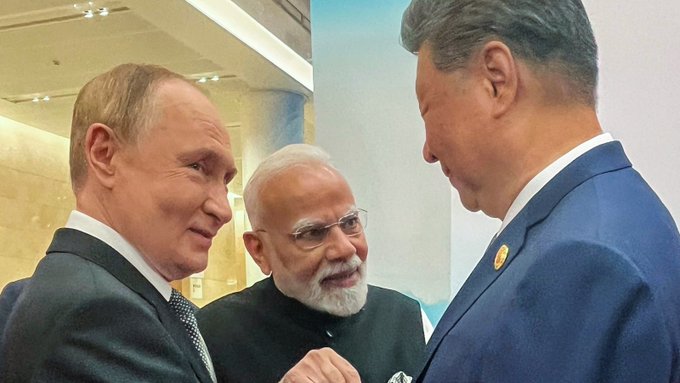
The expansion of Chinese influence into its traditional Central Asian sphere. A broad division of labor emerged, with Russia retaining its larger security role while China steadily became the dominant economic power.
The late 1990s also saw Russia entice India into a triangular forum with China to limit the dangers of the American unipolar moment. Then-Russian Prime Minister Yevgeny Primakov publicly proposed a Russia-India-China strategic triangle during his visit to New Delhi in 1998. India, wary of American pressure over Kashmir and nuclear proliferation, was willing to play along with the rhetoric of multipolarity even as its diplomatic energies increasingly went into improving relations with the United States.
The threesome was eventually subsumed by BRIC, BRICS, and today’s expanded version of that group. India was equally eager to join the SCO when it was formed in 2001 as an institutional structure for the Shanghai Five. Apprehensions about Pakistan gaining ground in Central Asia, the need for an active presence in the newly independent “stans,” and the prospect of greater cooperation on counterterrorism saw New Delhi push persistently for membership.
India became an observer in 2005 and, after the decision to admit it was taken in 2015, became a full member in June 2017. But it could enter only alongside Pakistan—awkwardly sharing space with Islamabad in a new regional forum even as an existing one, the South Asian Association for Regional Cooperation (SAARC), had already become paralyzed by India-Pakistan tensions.
Nearly a decade after India joined the SCO, both the regional context and New Delhi’s interests have shifted significantly.
First, the driving idea behind the bloc—promoting multipolarity by limiting U.S. power—no longer squares easily with India’s growing convergence with the United States, its Asian allies, and Europe, or with India’s mounting problems with China. The military crises on the border since 2020 have underlined the structural nature of India’s China problem.
Russia continues to enjoy considerable political goodwill in New Delhi, and the energy relationship has deepened. Yet there is no escaping the diminution of Russia’s salience in India’s overall calculus as Moscow struggles with the consequences of its war in Ukraine and the rupture of its relations with the West.
More broadly, notwithstanding Trump’s provocations, New Delhi has little reason to support the anti-American and anti-Western posturing that increasingly surrounds both the SCO and BRICS. The SCO allows India to put out diplomatic signals on its commitment to strategic autonomy and an independent foreign policy. But it does not solve any of India’s entrenched problems with China or elevate the partnership with Russia to a higher level.
Second, the SCO is no longer exclusively focused on Central Asia in a way that might boost India’s engagement with the region. It has become a sprawling assembly. It now has 10 full members, two observers, and 15 dialogue partners, stretching well beyond inner Asia to include countries such as Egypt, Saudi Arabia, the Maldives, Myanmar, and Laos.
As with BRICS, China has been eager to widen the SCO’s ambit. Arguably, Beijing’s interest is less in constructing a cohesive regional organization than in promoting its broader foreign-policy objectives—including Chinese ideas, discourse, and global initiatives. For China, it is the strength of its bilateral relationships with the Central Asian states, rather than the SCO itself, that secures its regional interests.
For New Delhi, meanwhile, the old idea of balancing China in Central Asia—on its own or through partnership with Russia—looks less impressive every day as the comprehensive power gap between India and China grows, massively, in Beijing’s favor. In the SCO as in BRICS, China towers over the other members, including Russia and India.
Third, given the SCO’s original focus on extremism and terrorism, India had hoped to mobilize the region around these shared concerns and leverage them against Pakistan’s support for cross-border terrorism. But as in other multilateral forums, China has been protective of Pakistan and has prevented India from using the SCO to isolate Islamabad.
Worse still, from New Delhi’s perspective, the SCO has produced a certain moral equivalence between Indian and Pakistani charges on terrorism. It is not a perspective that is shared by others in the SCO. The 2025 Tianjin Declaration “strongly condemned” the April 22, 2025, terrorist attack at Pahalgam, which triggered the India-Pakistan military confrontation in May. But it did not identify Pakistan as responsible.
In the very same passage, the declaration condemned the March 11 and May 21 terrorist attacks in the Pakistani province of Balochistan, which Pakistan has accused India of supporting. The SCO therefore acknowledged India’s concerns over Pahalgam while simultaneously giving multilateral recognition to terrorist attacks invoked by Pakistan in making its case against India. The result was less a regional consensus on terrorism than a diplomatic balancing of Indian and Pakistani narratives about each other’s support for attacks. New Delhi’s ability to put Islamabad in the dock on terrorism has diminished as the post-9/11 agenda on global terrorism fades and the interests of China and others in Pakistan now come into play.
Fourth, the SCO and BRICS have sharpened India’s larger problem of regionalism. If isolating Pakistan on terrorism has become difficult, New Delhi must now reckon with Islamabad’s growing diplomatic weight during Trump’s second term and its reintegration into the geopolitics of the Middle East.
Pakistan will take over the rotating chairmanship of the SCO after the summit in Bishkek next week and will host the organization’s annual summit next year. This will only add to the complications in India’s approach to Pakistan and regional institutions.
In light of its regional interests and misgivings vis-à-vis the SCO, the fact that India has not found a way to advance the SAARC is striking. That organization has not held a summit since Kathmandu in 2014, and Nepal continues formally as its chair because the planned 2016 Islamabad summit never took place. Meanwhile, India’s other South Asian neighbors have steadily developed links with the SCO: Afghanistan is an observer; Nepal, Sri Lanka, and the Maldives are dialogue partners; and Bangladesh has recently sought support from Russia and Tajikistan for joining the organization.
The irony is hard to miss. Even as SAARC remains frozen by India-Pakistan conflict, China-backed continental institutions are extending their political reach into the subcontinent.
Given its internal structure and distribution of power, the SCO is not in a position to address India’s key regional interests. It cannot generate geographic access to Central Asia. It will not alter Pakistan’s transit veto. It will not produce a credible regional response to Pakistan-based terrorism. Nor will it balance China’s growing influence.
The answers to these problems can only be found through a stronger Indian bilateral engagement with the Central Asian republics and partnerships with friendly powers to develop projects that can help New Delhi overcome its geographic disadvantages.
None of this means India should walk away from the SCO. New Delhi can continue to use the summits for bilateral diplomacy, resist formulations contrary to Indian interests through the organization’s consensus principle, and leverage the convenient access the forum provides to Eurasian leaders.
India’s experience in the SCO underlines a larger political truth. Multilateral institutions, whether regional or global, reflect the distribution of power. Stronger states use them to gain legitimacy for the pursuit of national interests, dressed up in the language of universalism or regional good.
Recognizing that China increasingly owns the SCO table is the necessary starting point for a realistic Indian engagement with the forum—with low expectations, modest objectives, and no illusions about what sitting at that table can deliver.
|